Photography Credit: Jeff Smith Photography
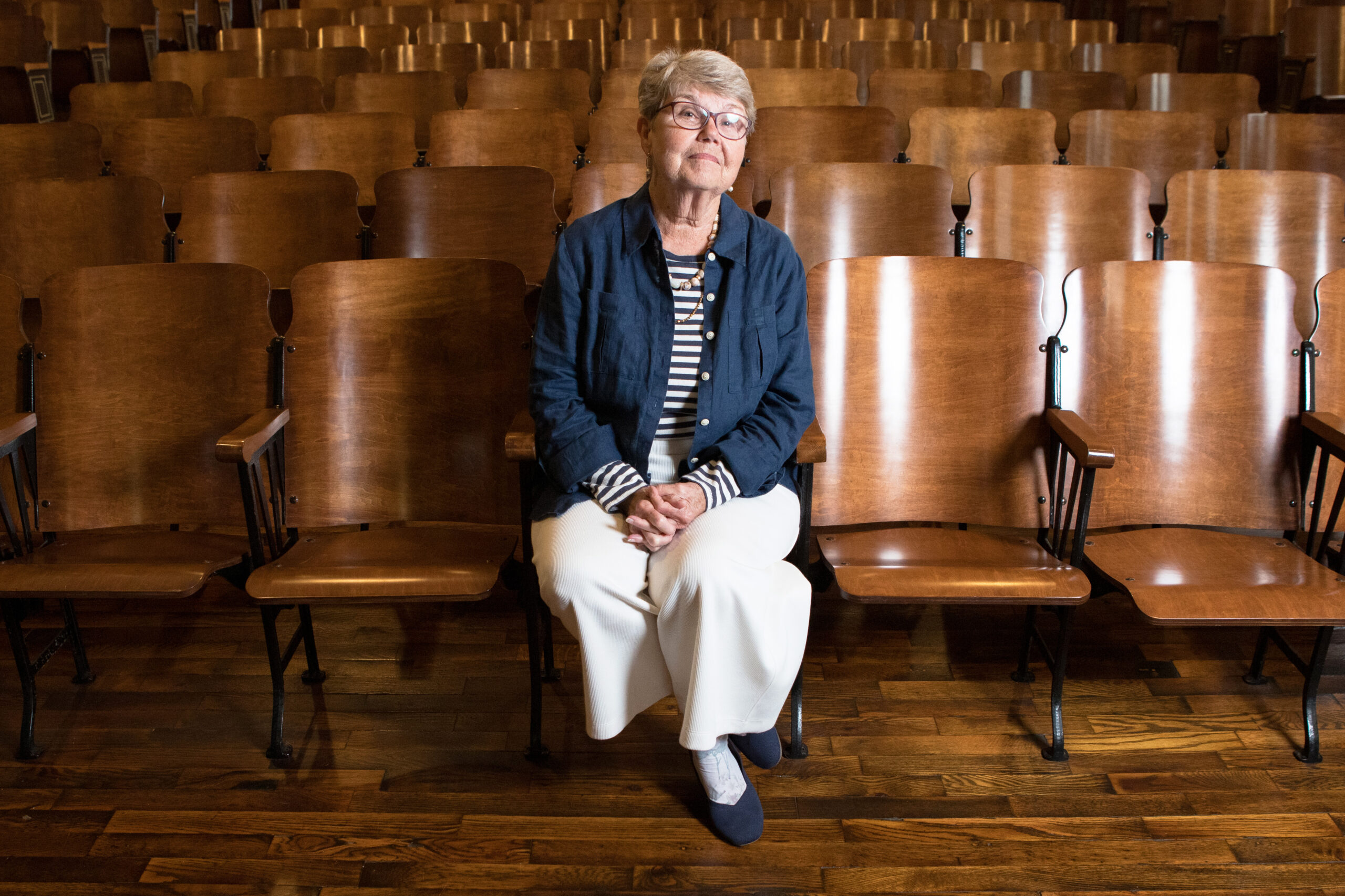
Ask anyone in the Stecoah Valley who put all of this together and they’ll likely all answer, “Lynn Shields.” Lynn is quick to rebut that Stecoah Valley School had a vibrant history of nearly 70 years of service to the local community before she encountered it – and that Tina Holland filed for the nonprofit two years before she stepped foot in it – and that she had good help. No matter the history, Mrs. Shields effectively cut the pattern that the Stecoah Valley Center follows today. She was the first executive director, and remained in that position for over a decade.
Mrs. Shields Comes to Stecoah
When Mrs. Shields and her husband bought their home in Stecoah, he had trout fishing in mind and she was left with large amounts of time to amuse herself. While out exploring, she stumbled upon the historic Stecoah school and “fell in love with it.” The school had shut down with the final consolidation of Graham County schools in 1994. As students and faculty left, so did any maintenance funding from the state. Knowing that the county had recently demolished another school building, Stecoah fought hard to keep its fondly-remembered stone schoolhouse. A nonprofit Community Resource Center was formed with a library and an afterschool, allowing the building to be leased from Graham County. Mrs. Shields was installed over the afterschool, and after finding funding, quickly became the Stecoah Valley Cultural Arts Center’s Executive Director in 1999.
I had never written a grant in my life, but when I got here the roof was leaking so badly that one of the first things I did was go buy buckets and put them in the hall to catch the rain.” As it turned out, Mrs. Shields, a former CPA who went back to school and later became a designer at an architectural firm, was particularly well skilled for the task at hand. Now, neither of those things are a roofer, but they facilitated finding the money for a roof. “I wrote a grant to the Percy B. Ferebee Foundation out of Asheville whose purpose was to help remote rural areas,” Mrs. Shields continued matter-of-factly. “They granted us funds for a new roof; we got a new roof, and that was the first real big improvement to the Center.” With that success, she took it upon herself to learn whatever was needed to preserve the school.
“I tried painting, but my husband didn’t approve of that. He thought that we should be able to hire somebody else to paint.” So, Mrs. Shields would leave her painting clothes at the Center and change once she arrived at work only to change again before going home. “I have painted a good bit of this building.” Where there was need, there was gumption to match.
Establishing An Appalachian Evening
The community-focused nonprofit within the little schoolhouse in Stecoah began to grow through connections with larger organizations. However, it would be a few years before the inaugural concert series was conceived. “It seemed to me there was no way we could make enough money or write enough grants to keep the place open if it only had a community focus,” shared Mrs. Shields. There were many ideas to solve the problem, including converting the school into a hostel for hikers. Thankfully, Mrs. Shields established a connection with the North Carolina Arts Council and they came together with the board for a weekend long retreat. Out of that weekend was born the idea to establish music programming, “I came up with the idea of a summer concert series, so we started An Appalachian Evening in 2000, and have been going every summer, except when it paused the year of COVID.”
The An Appalachian Evening concert series would go on to highlight the building’s rich musical history, bring an audience into the multifaceted building, and win them to the other cultural programs such as the gallery, the JAM program, and arts classes. Little did she know at the time that professional roots music had graced the stage many years before. (see Stecoah History pg 4-5) “I wasn’t aware of any famous musicians being there prior to the concert series. What everybody knew and recognized was that music was special to the mountains and that if we could do this it probably would attract an audience of supporters, participants, and volunteers.”
Restoring the Auditorium
It’s safe to say there was an objective, but there were so many steps to get there. Not only did someone have to dive into the world of professional folk musicians, but the auditorium had some pressing needs to be addressed. How to know where to start? “It was almost exclusively based on grant funding. If we had a grant to work on the building, those funds went to work on the building. If we had a grant to provide artists for the summer series, that’s where those funds went. The cost of renovating the auditorium was substantial, but they depended on each other. If you didn’t have a good venue you couldn’t have good music. If you had a good venue without good music, you had nothing.”
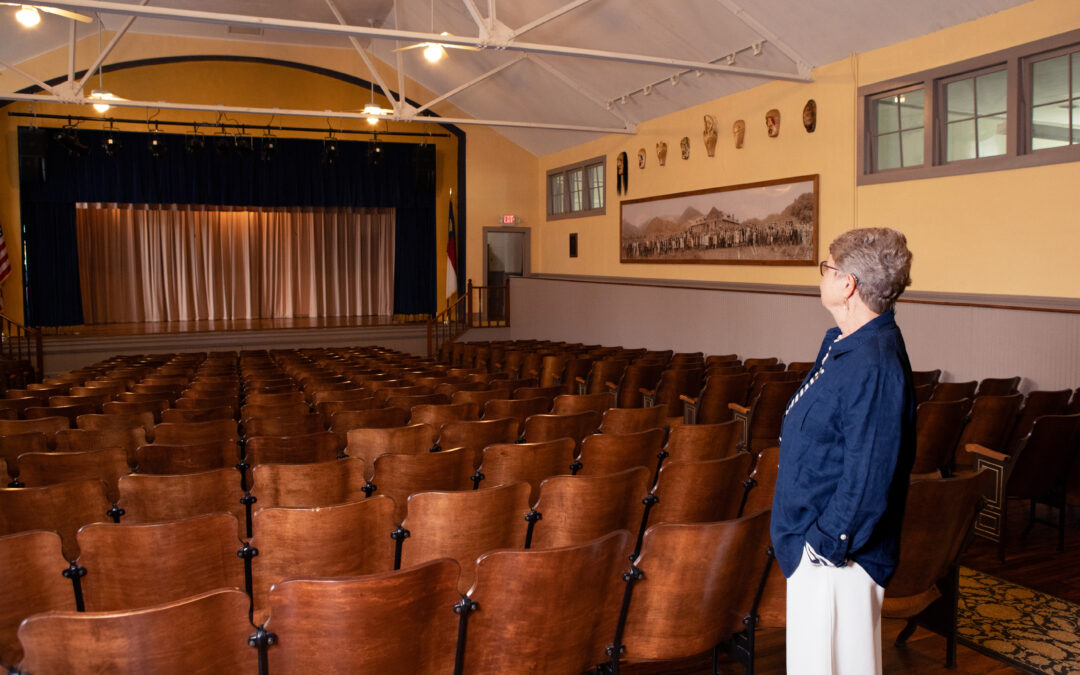
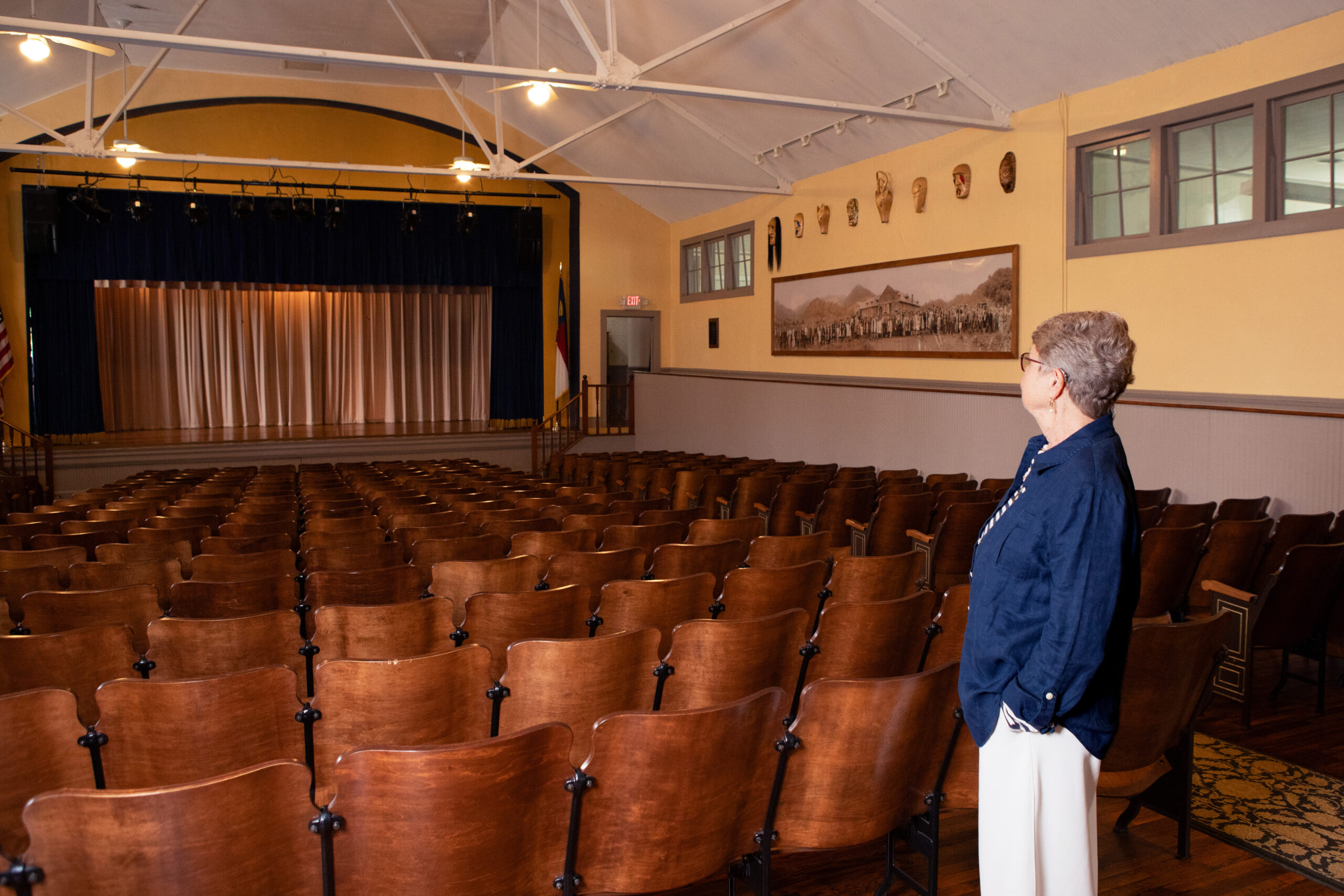
At this time, there was a drop ceiling in the auditorium and for all the staff knew, that’s all there was. There was no heat or air conditioning, and so open windows and fans were the humble beginnings of the series. With time, work, and grants, more and more improvements were possible. The old radiators were removed, new air conditioning installed, level walkways were built to connect the two wings for handicapped accessibility, and a basic soundboard and stage lighting system were purchased. The original chairs were removed to be refurbished, the floor refinished, and the drop ceiling removed, all of which restored the acoustics that would’ve been present in the 1920s. (see Abernathy pg 36)
Mrs. Shields remembered the day the architect visited and discovered the arched ceiling, “He climbed up a very tall ladder, lifted up one of the acoustic tiles and saw the arch above the stage. ‘Lynn, you gotta climb that ladder and look. It’s gonna be beautiful when we take this ceiling down,’ he said.”
Venue? Check. But now to plumb the depths of networking among musicians that could draw an audience. Determined as always, Mrs. Shields found an opportunity and drove across the state to Wilmington. “Harvey Seay and Gladys Eichenberger helped get the program together that first year. We used a number of local artists as performers because we couldn’t afford to pay.” At the ArtsMarket convention in Wilmington, Mrs. Shields walked around saying, “I’m from the mountains and I don’t know a blooming thing about music. I have no music in my background, but I know music is important to the mountains. I have a little bit of money and I’m trying to put together a concert series. Can you help me?” She laughed, “Truly, that’s how it worked.”
You can find the archives of performers at StecoahValleyCenter.com and see the evolution of the programming over a quarter century. The star power grew each season, but at the heart of it all was the nonprofit’s charter mission “to serve the people of Stecoah and Graham County through programs and services that benefit all members of the community, through the preservation and promotion of Southern Appalachian mountain culture and through the restoration of the historic old Stecoah School to its original role as the center of the community.” Lynn Shields believed that and leaned into it.
Photographer Credit: Jeff Smith Photography
Building An Audience
When asked about the goals of the concert series, Mrs. Shields emphasized cultural authenticity, the audience experience, and using grant funding with integrity. “I guess I always thought that if it was an accurate presentation of mountain music, whether it was bluegrass, country, or old time – whatever it was – that it would be memorable. So I didn’t try to make them memorable, I just tried to make them right. I felt very strongly that the series should be good all the way through from beginning to end so that it did not matter which Saturday night you went to Stecoah, you were gonna see a good show.”
The first years were very small in attendance, with mostly tourists and some locals. In fact, the first year, Mrs. Shields roped off the back seats of the 320 seat auditorium to make people sit up front. As the series went on, it got better. She wanted the first goal of a hundred tickets so badly, she was willing to buy the last few herself. The goal was reached organically in the second season, and over the years, even sold out at times. (see Stewardship & Soldout Shows pg 27)
As the music played on Saturday nights, Mrs. Shields stood stageside in her capacity as executive director, Stecoah resident, and an appreciator of culture. “It gave me pleasure to know that we were doing something that people appreciated and people would pay money – little or big – to come see. I enjoyed the music and I enjoyed knowing that we were preserving and presenting mountain music.”
When asked if there was ever a possibility that An Appalachian Evening would never have gotten off the ground, she crossed her arms, leaned over the table, and with eyebrows raised said, ”There was a real possibility because I didn’t know beans about what I was doing. Without grants, key organizations, volunteers, or music, we could not have made it happen.”
It’s hard to argue with time – countries rise and fall in a quarter century. An Appalachian Evening keeps ticking through changing times, bringing back authentic, southern Appalachian music from award-winning professionals summer after summer. Looking forward to the next 25 years, her advice is simple. “In my opinion, as long as you stay true to the preservation of Southern culture, Appalachian culture, the series may go up and down but it will survive. And that’s the whole thing. We were just running by the seat of our pants trying to do the best we could – but look at the result.”
That result has been witnessed by thousands, including many bluegrass and folk professionals. In the corner of the auditorium she fought for hangs a plaque that officially named the room the Lynn L. Shields Auditorium in 2011. It cites her years of vision, leadership, and perseverance. The quote etched at the bottom, a favorite of Mrs. Shields, reads, “Never doubt that a small group of thoughtful, committed citizens can change the world. Indeed it is the only thing that ever has.” – Margaret Mead