This Saturday, August 17th, the Kruger Brothers will perform on Stecoah’s Grand Old Stage. (Click here for concert details.) Today we are sharing the second of a two part series from our An Appalachian Era publication celebrating 25 years of mountain music through the Stecoah’s An Appalachian Evening concert series. This series, titled Rule Breakers, introduces readers to two annual concert series performers who bring very unique approaches to traditional mountain music – Jeff Little and the Kruger Brothers (p. 32-35). You may purchase this commemorative publication either at the Stecoah Valley Center or the Welcome Center on 474 Rodney Orr Bypass.

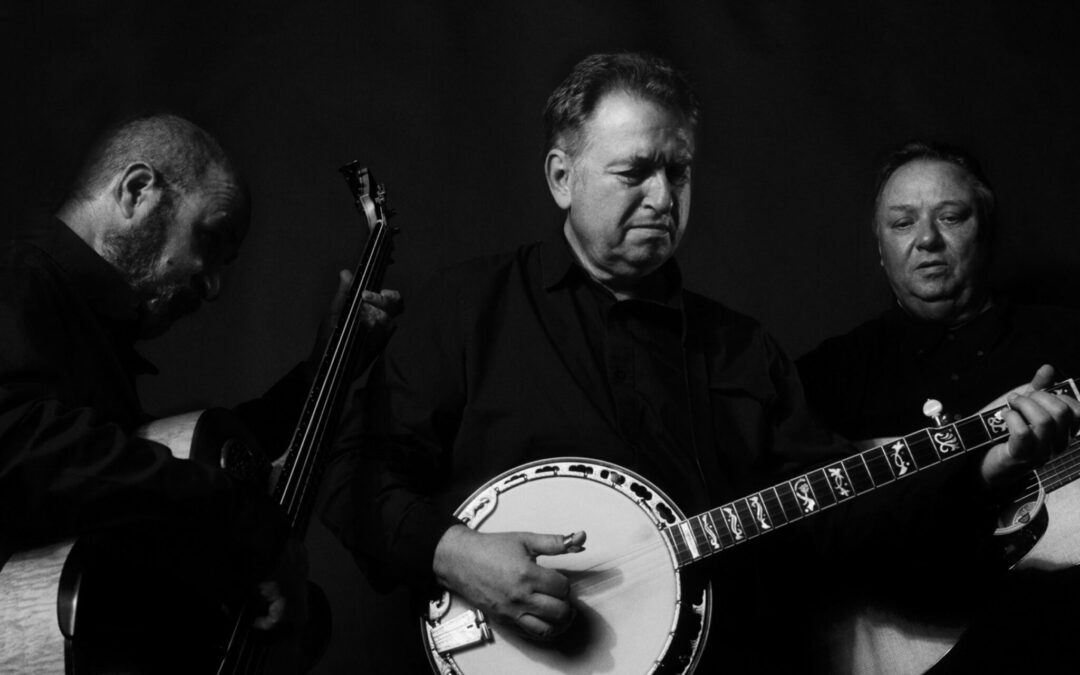
From L to R Joel Landberg, Jens Kruger, Uwe Kruger
Raised in a region of Europe famous for classical compositions, Jens Kruger of the Kruger Brothers was glued to the radio as a child, listening to American music – most of all, bluegrass. “My father listened to Dixieland, Chet Atkins, and Hank Snow while we had a broader range of musical tastes. I was fascinated by the sound of the banjo – how pure and clear and beautiful it was. I asked my mom, ‘Are there people who only do that?’ and she said, ‘Yeah, they’re called musicians.’ I said, ‘well, that’s what I want to do.’”
Style & Cultural Influences
Due to constant cultural immersion, many Appalachians think of Earl Scruggs or Grandpa Jones when they hear a banjo, but its origins are African with a unique drum head and prototypical gourd back. In the time between Africa and Earl, the banjo has a history in — believe it or not — classical music. Alfred A. Farland presented Beethoven compositions on a banjo, wearing a tuxedo, as early as the 1880s. The culture moved it from minstrel music to operas with orchestras, and then to old-time and bluegrass. And somewhere between the European classical composers and the American 3-finger style banjoists was Jens Kruger, a unique hybrid.
Barely an adult, Jens spent a season with the Father of Bluegrass himself, Bill Monroe, to learn about the American folk music that he’d heard on European radio. “He asked me once, ‘What do you want to do?’ I told him I just wanted to play banjo and bluegrass. He said, ‘Don’t do that. I already beat you to it. If you want a career, base your music on a folklore that’s accepted, understand the language of musical phrases, and then add yourself to it and show them what your ideas are. Go home, develop your music, and then come back.’”
“I had all these different kinds of music in me. As I started writing my own music, they merged into a sound coming out of my banjo, maybe a different sound than somebody who grew up in North Carolina, for instance. I just had different cultural influences. People ask, ‘Why do you play bluegrass in Switzerland?’ We could ask, ‘Why do you play Bach in New York?’ You know? This is our music. Beethoven, Bach, Haydn; these are German and Austrian composers. This is our culture. This is our folk music.”
Listen below for a beautiful example of Jens beautiful style of playing classical music on the banjo.
Moving to the States
Valuing Monroe’s advice, brothers Jens and Uwe began to tour the United States some years later, eventually moving permanently to North Carolina and befriending Doc Watson. Uwe was the skilled and
spontaneous singer and guitar player, perhaps more of the rocker, while Jens leaned into writing music, marrying classical to bluegrass using his talent on the banjo. “Uwe and I are like both sides of a coin.
Working together produces variety and that makes him just as happy as me.” Rounding them out with tasteful and technical low end was former college classmate Joel Landsberg on bass, forming the Kruger Brothers that we now know and love.
“The music in North Carolina was always fascinating for us because the people who came here didn’t put their music into a specific genre. We heard Doc Watson on the radio in Europe and getting to know him, he had such love for the music from here, which is not genre limited. All these German, Irish, and Dutch elements are in there. There’s ballads, lots of gospel music, dances and waltzes and reels. Doc put them all together and interpreted them in such an accessible way, in a spirit that is so free. When you listen to American folk music recorded from the Appalachians in the mid-20s, you can hear all kinds of instruments too, dulcimers, and even bagpipes. In the end, it really doesn’t matter if you play it on a mandolin or an accordion or a guitar or piano, that’s the beauty.”
The beauty of blending characteristics shines in the depth and sophistication of Jens’ pieces like Music from the Spring, Appalachian Concerto, and Roan Mountain Suite. Maybe Bill Monroe felt the same accomplishment after completing Jerusalem Ridge, a song so unique, it could only be his, but so relatable that anyone could enjoy it. Jens Kruger, through both originality and cultural influences, reaches a wide audience with his music.
Playing Stecoah’s Grand Old Stage
Among all the travel, festivals, symphonies, and accolades, Jens, Uwe, and Joel have graced the Stecoah stage more than any other artist in the An Appalachian Evening series – this season will mark 20 years since their first appearance. It’s for good reason; the Kruger Brothers with their personable demeanor, creative material, and flawless execution energize crowds. The fans that attend with cowbells are an indicator that they remain one of the hottest tickets of the series.
“Noble places and concert halls, we’ve played lots of them. But in the end, the hall is just a pile of bricks. What’s important is the people and the atmosphere that you create that evening. Everything else is secondary. I’ve had some of my best evenings in my life, you know, in places like Stecoah. You always have a feeling like you’re sitting in an oversized living room with a lot of friends.”
Listen below to hear the Kruger Brothers talk about their background and their love for the Stecoah Valley Cultural Arts Center in their own words.