
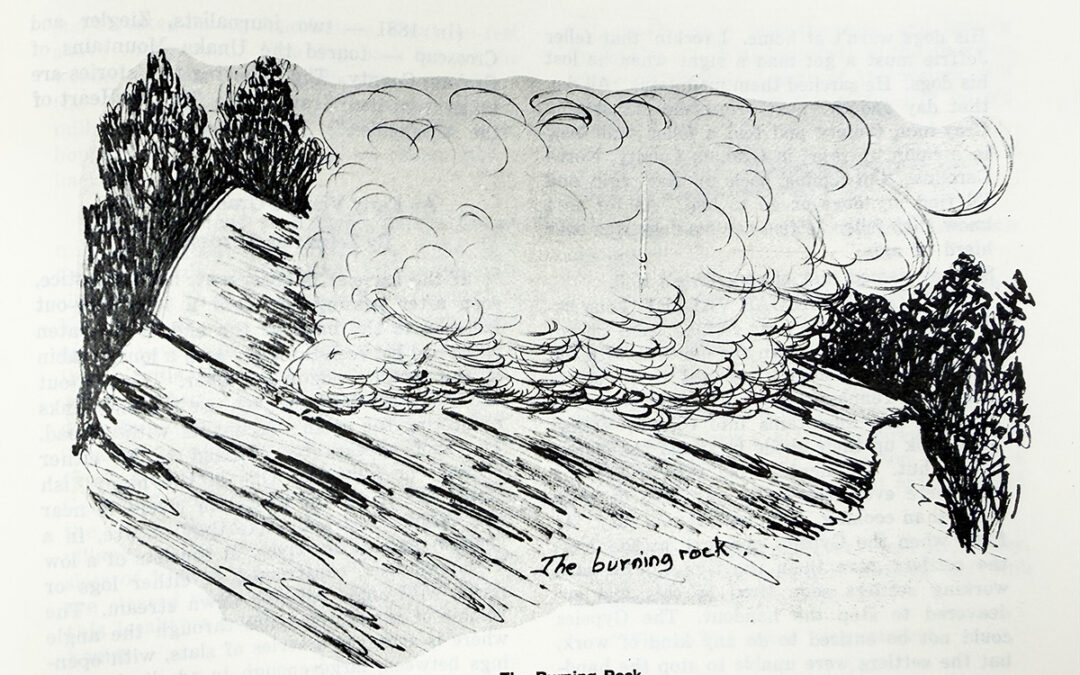
According To Local Legend
Around 1880 a couple of men likely out hunting stopped to camp on a ridge deep in the woods of Big Snowbird. It was a cold night but they were sheltered against a rocky bluff protected from the wind. In Marshall McClung’s version of the story they built a fire in a large chestnut with a hollow base and bedded down till daylight. In Wanda Stalcup’s version of the story published by Tipper Pressley on the Blind Pig & The Acorn, the men “had a few spirituous drinks and kindled their fire and soon fell asleep.”
Before sunrise they were awakened with a start — the woods all around them were ablaze. Racing to flee the flames they climbed to the top of the ridge which in that area stands around 4,000 ft of elevation. Standing on higher ground looking back at the fire they were confounded — the worst of the blaze was not in the trees; rather it was coming out of a large rock on the bluff. The ground around the boulder was beginning to form a crater.
They watched with consternation as the explosions began and chunks of flaming rocks fell all around. Shaken and fearing for their lives they fled.
The blasts woke people from their beds ten miles away. Residents stumbled outside to see the mountain aglow with fire and brimstone falling out of the sky. The fire continued to burn until dawn with no stopping. In fact, it is said to have continued to burn for six weeks with a smoke so thick and black that sometimes it blocked the sun and caused chickens to go to roost midday. The smoke left a sticky, oily soot that clung to the leaves of trees and scattered over the ground. Stalcup’s retelling described a “strange odor as if rags were burning.” Even long after the fire died down, live coals were seen burning in a crater that was large enough for a house.
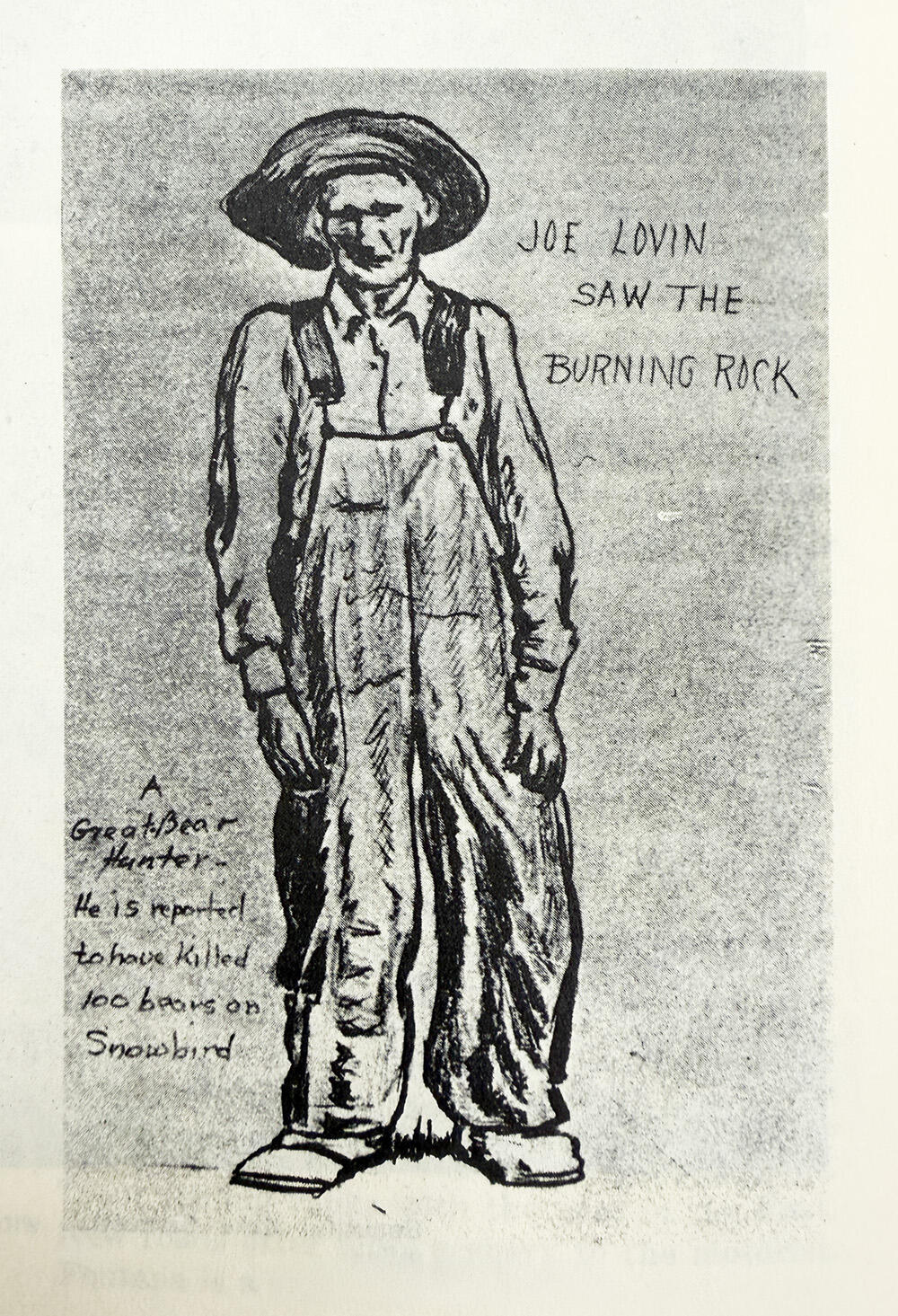
Joe Lovin of Snowbird, remembered as a bear hunter on Big Snowbird and, by family account, saw the burning rock. Illustration from the Graham County Centennial, illustrated by Mary Howell.
They Thought It Was The End Times
Many versions of this story have been passed down over the years but one thing that is consistent in all of the tales is the panic that ensued. Many were convinced that the end of the world had come — people dropped to their knees to pray or confessed their sins where they stood. Churhes filled. Some kept a wary eye on the cemeteries to see whether the dead would rise.
The Site Has Never Been Found
Having heard these stories all his life, local storyteller Marshall McClung tried to trace this story down. He found a variation passed down by the Lovin family to be the most credible — the Sam and Lavina Johnson Lovin family were early settlers in the Snowbird area.
He and his friend Hoot Gibbs decided to set out to find the site of the burnt rock when they were older. Marshall collected an account from Blake Wilkey who remembered seeing the crater when he worked along one of the logging railroads in Big Snowbird. Marshall and Hoot are two of the most experienced hikers in Graham County. Marshall in particular, has participated in hundreds of rescues in the Snowbird backcountry. Together they went looking for signs of the burnt rock and crater but came home with nothing to show for their efforts.
This story remains one of the greatest Graham County mysteries to this day.
Hiking in the Backcountry
The Snowbird Backcountry and the Joyce Kilmer–Slickrock Wilderness are among the most rugged and least developed country in the Southern Appalachians.
Trails here are lightly traveled, often overgrown, and frequently blocked by blowdown. In designated Wilderness, there are no blazes — only signs at trail junctions. Old logging grades frequently cross trails easily confusing inexperienced (and sometimes experienced) hikers.
Before You Leave Home
- Check current conditions with the Cheoah Ranger District — trails close for fire, storm damage, and washouts, sometimes with little notice
- Carry a paper map and compass, and know how to use them. Cell coverage is unreliable to nonexistent across most of this country; never rely on phone navigation.
- Tell someone specificically where you’re going and when you’ll be back
- Pack for a night out even on a day hike: extra layers, light, water, food; a waterproof layer is recommended
On the Trail
- Stay on established trails. Dense rhododendron and laurel thickets in this terrain make off trail travel treacherous; steep drops aren’t visible until you’re on them
- Turn around earlier than you think you need to. The way out takes longer than the way in
- If you lose the trail, stop. Retrace to your last known point rather than pushing forward
Trail Maintenance
These trails are managed by the U.S. Forest Service, Nantahala National Forest and by the volunteers of the Partners of the Joyce Kilmer-Slickrock Wilderness. Search and rescue in Graham County is run largely by volunteers.
About the sources
This story was retold by Marshall McClung and appears in More Mountain People – Mountain Places (self-published; printed by Print Edge, Knoxville, Tennessee, 2011). Used with permission.
McClung is a Graham County native, born and raised in the Atoah community. He is retired from the U.S. Forest Service and spent many years with the county rescue squad, where his tracking skills helped locate hundreds of lost people. He has written local history for The Graham Star for decades.
This book and others by Marshall McClung can be purchased at The Stecoah Valley Artisan Gallery and other local gift shops.
Stalcup, Wanda. “Burnt Rock Ridge, Graham County, NC.” Published by Tipper Pressley, Blind Pig & The Acorn. blindpigandtheacorn.com