
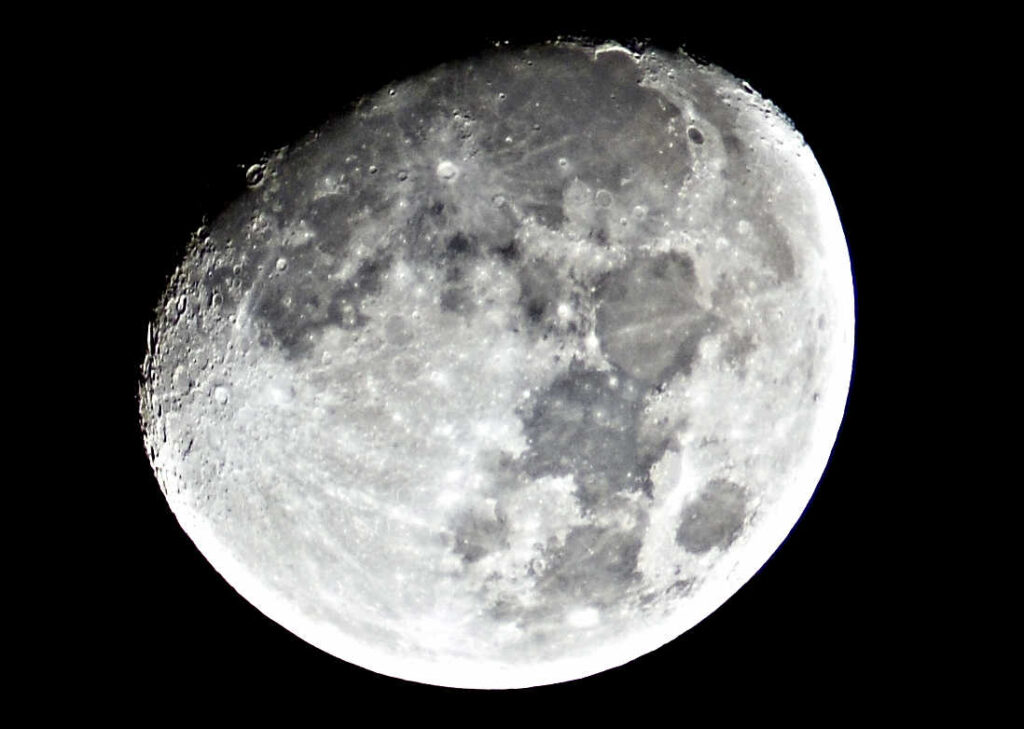
On October 12, 2024 we will conduct our annual, International Observe the Moon Night in the parking lot of the Graham County Public Library in Robbinsville, North Carolina. In addition to the Moon, the evening also promises telescope-enhanced viewing of the planets Jupiter, Saturn and Mars and one furtive, but spectacular visitor! A new comet is going to grace the skies in the Northern Hemisphere during October of 2024.
Numerous images of this celestial firework C/2023 A3 (Tsuchinshan-ATLAS), have been showing up on social media platforms over the last two weeks photographed by amateur astronomy enthusiasts in the Southern Hemisphere. It is clear that this comet promises to be a highlight of the year as it makes its way across our solar system. Early indications hint that its brightness will offer a stunning display for stargazers worldwide.
Whether you’re an experienced astronomer or a casual observer with just your eyes or a pair of binoculars, this comet’s passage presents a chance to experience the excitement that these messengers have evoked in earthbound observers for centuries.
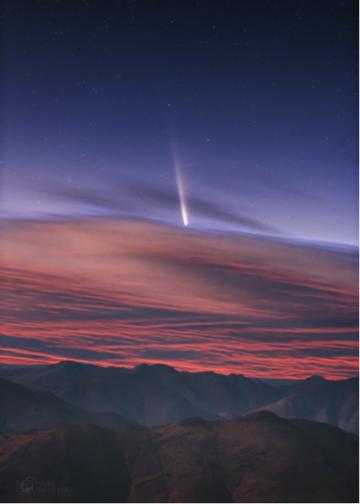
Credit: Yuri Beletsky, Carnegie Las Campanas observatory, Atacama desert, Chile 9/26/2024
Comet Tsuchinshan-ATLAS approached perihelion (the point at which it is closest to the sun) at the end of September. Numerous independent observers reported that it had achieved an apparent magnitude of +3, meaning it will very likely be visible to the unaided eye under dark sky conditions into October. The viewing window for this rare astronomical event will begin during the early morning hours of the final days of September and continue into October. During this part of it’s journey, however, it is the residents of the Southern Hemisphere who have the best opportunity to observe the comet. Here in the Northern Hemisphere C/2023 A3 is very, very close to the Eastern horizon during this time.
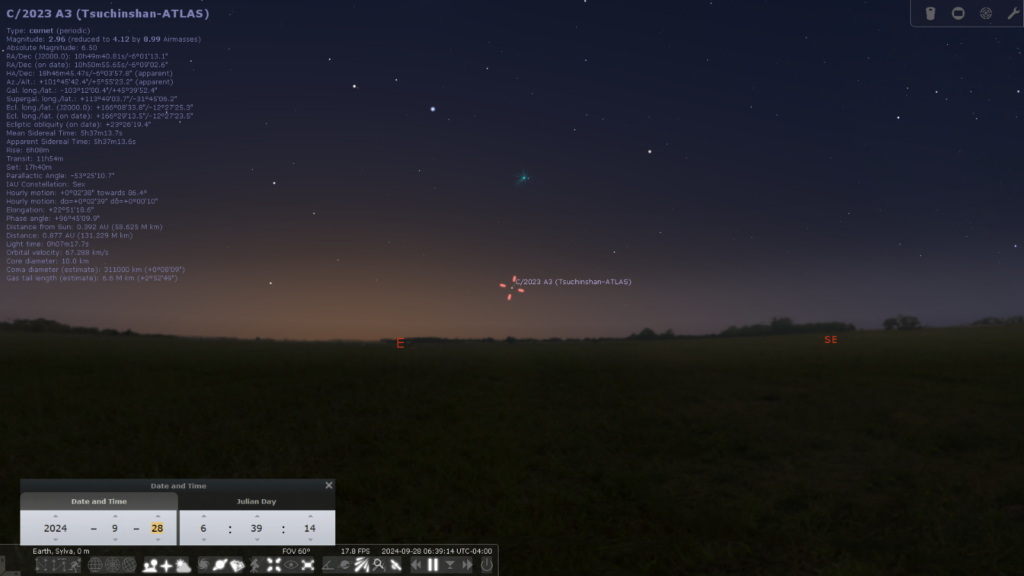
Beginning on September 30th the comet reaches Perihelion (the closest point) in it’s orbit around our Sun. This close to the sun, it will be obscured from our sight. It does re-emerge, however in the evening sky, making it’s final appearance on October 12th – the night we will Observe the Moon. While I cannot unequivocally promise a comet in the eyepiece on that evening, we can definitely talk about how one can plan to find it for themselves.
A caveat: The astronomer David H. Levy once wrote, Comets are like cats; they have tails, and they do precisely what they want.
They are enigmatic, spectacular and prone to hype. I am trying to avoid rampant expectations here but this comet has proven itself in a number of ways. It has been visible to the human eye in dark locations, which Graham county is blessed with.
Comets brighten as they approach the sun (perihelion). This is because they are closer to the brutal assault of the solar winds, which dislodge debris from the surface, throwing it into the space surrounding the comet’s core, lengthening it’s “tail”. Close Provimity to the sun also provides more light for the comet to scatter. As the comet recedes back into space it scatters increasingly less and less light and so will dim to the observer. Then, too, there is the occasional calamity. On rare occasions the comet may disintegrate due to the immense gravitational forces and thermal bombardment it receives from our sun.
Bring a good pair of binoculars with you if you want to have the best chance of catching a glimpse of Tsuchinshan-ATLAS. If your goal is to capture a picture I would suggest a tripod mounted DSLR with a fast 100mm or so focal length lens. Set to low f ratio, a fast ISO (1600 or so) and a 2-10 second exposure.
We can’t wait to see you on October 12, 2024 at the Graham County Public Library for International Observe the Moon Night in Robbinsville, North Carolina.
Good Hunting
Jim Baker, Stecoah, NC