Stories Told By The Men Who Worked The Graveyard Shift
Graham County, North Carolina, is home to three hydroelectric dams built to make electricity for aluminum production. A fourth, Calderwood stands just across the state line in Tennessee. Ghost stories have been passed down for generations by the men who worked the graveyard shift in these dams and powerhouses — a soldier who died of pneumonia in a barred room, footsteps with nobody there, and a breath on the back of a neck. These stories were collected by Graham County historian and award winning author, Marshall McClung, in his book, More Mountain People – Mountain Places.
A dam is a strange place to work at night. These enormous concrete structures are dark, damp and full of water moving under pressure through spaces you cannot see into. But for the men who worked them every day their hearing became accustomed and the familiar sounds receded into the background. The men in these stories were not looking for a ghost — but to their trained ears, something that isn’t water becomes very easy to hear.
Everett Williams, who told several of these accounts to Marshall McClung, said it best, “Don’t look behind you.”
Who Built These Dams, and Why
Smelting aluminum takes an extraordinary amount of electricity, and in the 1910s the cheapest source was a river with a steep drop. The Little Tennessee river falls through a series of steep gorges on its way to the rolling hills of Tennessee. The Aluminum Company of America bought up its watershed through a subsidiary called the Tallassee Power Company with the intention of powering a smelter in Alcoa.
Cheoah Dam was built first. A construction camp was established at the Narrows in 1916, rail service reached the site that September, and the first concrete was poured in March 1917. The powerhouse began operating on April 6, 1919. At 225 feet it was the tallest overflow dam in the world, and it carried the longest transmission line span anywhere — 5,010 feet across the river below the dam. The camp was renamed Tapoco, a name coined from the first two letters of Tallassee Power Company. There was a twenty-five dollar prize given for the name that locals still use for the dam today.
Santeetlah Dam followed. Work began in 1925 and the development was completed in 1928, impounding the Cheoah River above Robbinsville. The dam is 212 feet high and 1,054 feet long.
Fontana Dam, the largest, is still the tallest dam east of the Rockies today. It was built by the Tennessee Valley Authority and completed in 1944 during the war.
Don’t Look Back, Cheoah Dam
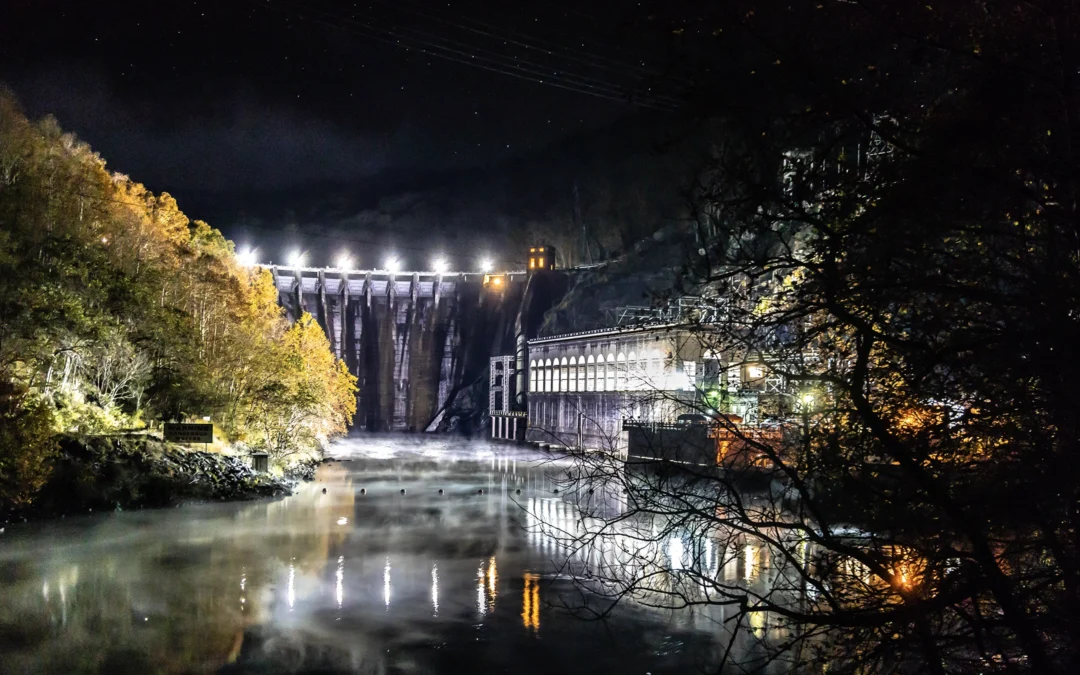
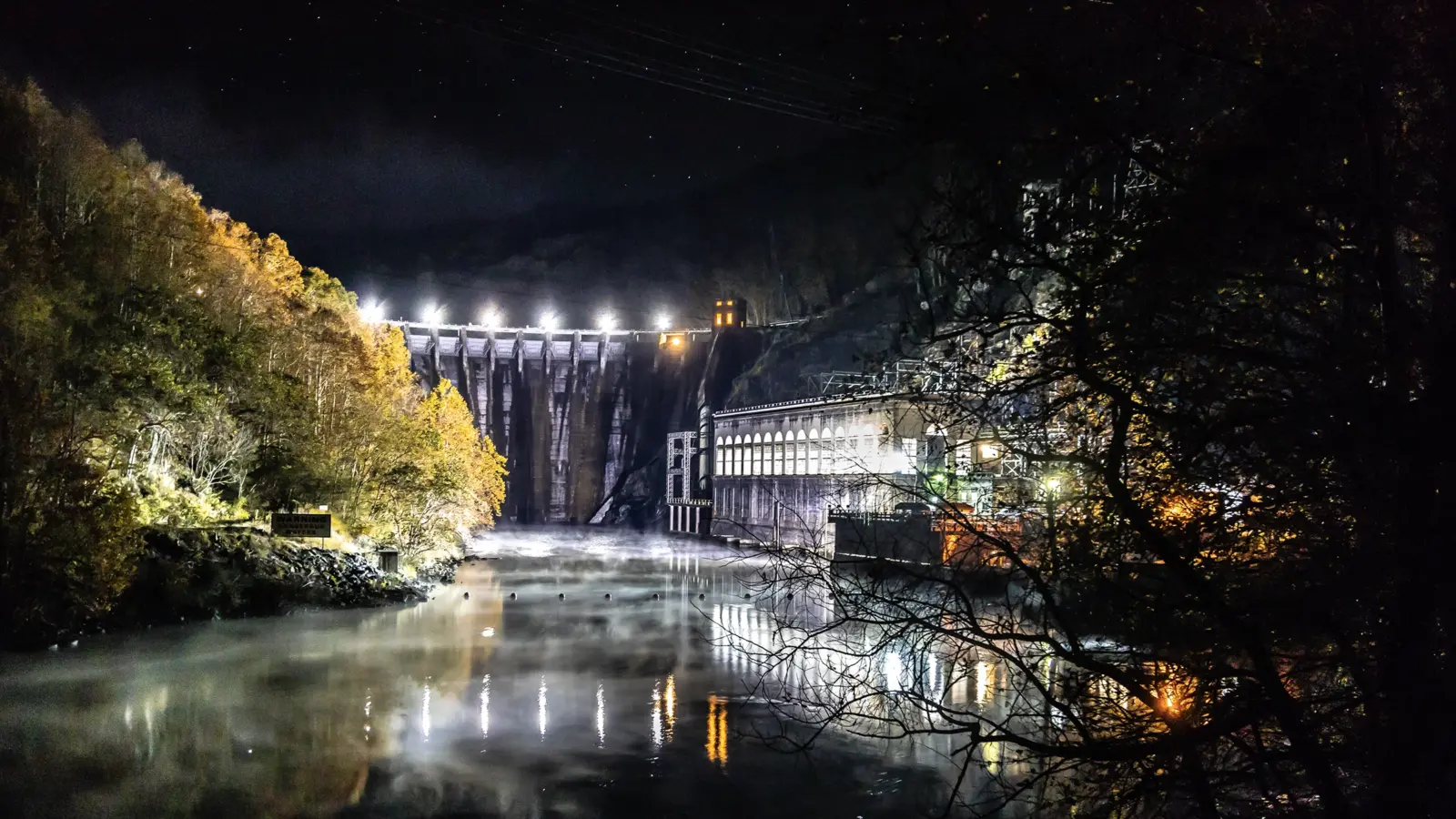
Cheoah Dam may look familiar to our visitors because of Harrison Ford’s famous spillway scene in 1993’s The Fugitive. The dam is 750 feet across with nineteen steel tainter gates, wedged into a gorge so tight the scale doesn’t register until you’re underneath it. Locals often refer to this dam as the Tapoco Dam.
An employee on the graveyard shift had someone or something blow on the back of his neck. He turned around and was struck across the face.
Don’t look back.
The Soldier On The Steps, Santeetlah Dam
Santeetlah Dam’s layout is unusual because of its great length and because its powerhouse is located five miles downstream. Water leaves the reservoir through an intake in the dam and travels through a steel pipeline, eleven feet across. The pipeline traverses five tunnels and crosses six elevated sections before it reaches a standpipe on the hill above the Rhymer’s Ferry Powerhouse and drops to the turbines below. You can drive under one of these elevations on Yellow Creek Rd from Highway 129.
The dam itself is a large structure with dark interior passages, stairs, and at least one section fitted with bars. A foul odor is said to emit from the dam that can take your breath.
A soldier who had gone AWOL was captured in Graham County and held in that section of Santeetlah Dam as a makeshift jail. He contracted pneumonia and died in the cold wet cell. Men who have worked there over the years report that he can often be heard sloshing through the water on the steps inside the dam.
Once, a large man nicknamed ‘The Hulk’ by Delmas McRae was hired to weedeat on the property. He was alone behind a locked gate and heard footsteps coming up out of the dam but could see no one around. He loaded his weedeater and left and would never return by himself again.
A Glimpse Of Employees Past, Rhymer’s Ferry Powerhouse
An employee was on duty in the control room when he caught someone pass by out of the corner of his eye.
It was a man he knew — an employee who had died four years earlier at fifty-four. He looked considerably younger than he had at the end. The figure disappeared while he watched.
Don’t look back.
That’s Just Stanley, Calderwood Dam
At the Calderwood Dam, across the state line in Tennessee, doors are said to open and close on their own.
Years ago there was a prison break in that part of Tennessee, and an escapee was seen swimming the river nearby. Officers swarmed on the area and saw a man cross the road and go into the cemetery, wearing a sweater and a toboggan. They asked a Calderwood supervisor who he was.
“Oh, that’s just Stanley.”
They pressed the supervisor and demanded to know who Stanley was and to be taken to him. The supervisor walked them over to the cemetery and showed them Stanley’s grave.
Where Can You See These Dams
Drop by the Graham County Welcome Center or any of our larger attractions to pick up a Scenic Driving Loop Map and drive the Three Dam Loop.
Attribution
About the source
The dam and powerhouse stories in this piece were collected by Marshall McClung and appear in More Mountain People – Mountain Places (self-published; printed by Print Edge, Knoxville, Tennessee, 2011). Used with permission.
McClung is a Graham County native, born and raised in the Atoah community. He is retired from the U.S. Forest Service and spent many years with the county rescue squad, where his tracking skills helped locate hundreds of lost people. He has written local history for The Graham Star for decades.
Several of the accounts here were told to McClung by Everett Williams.
This book and others by Marshall McClung can be purchased at The Stecoah Valley Artisan Gallery and other local gift shops.