


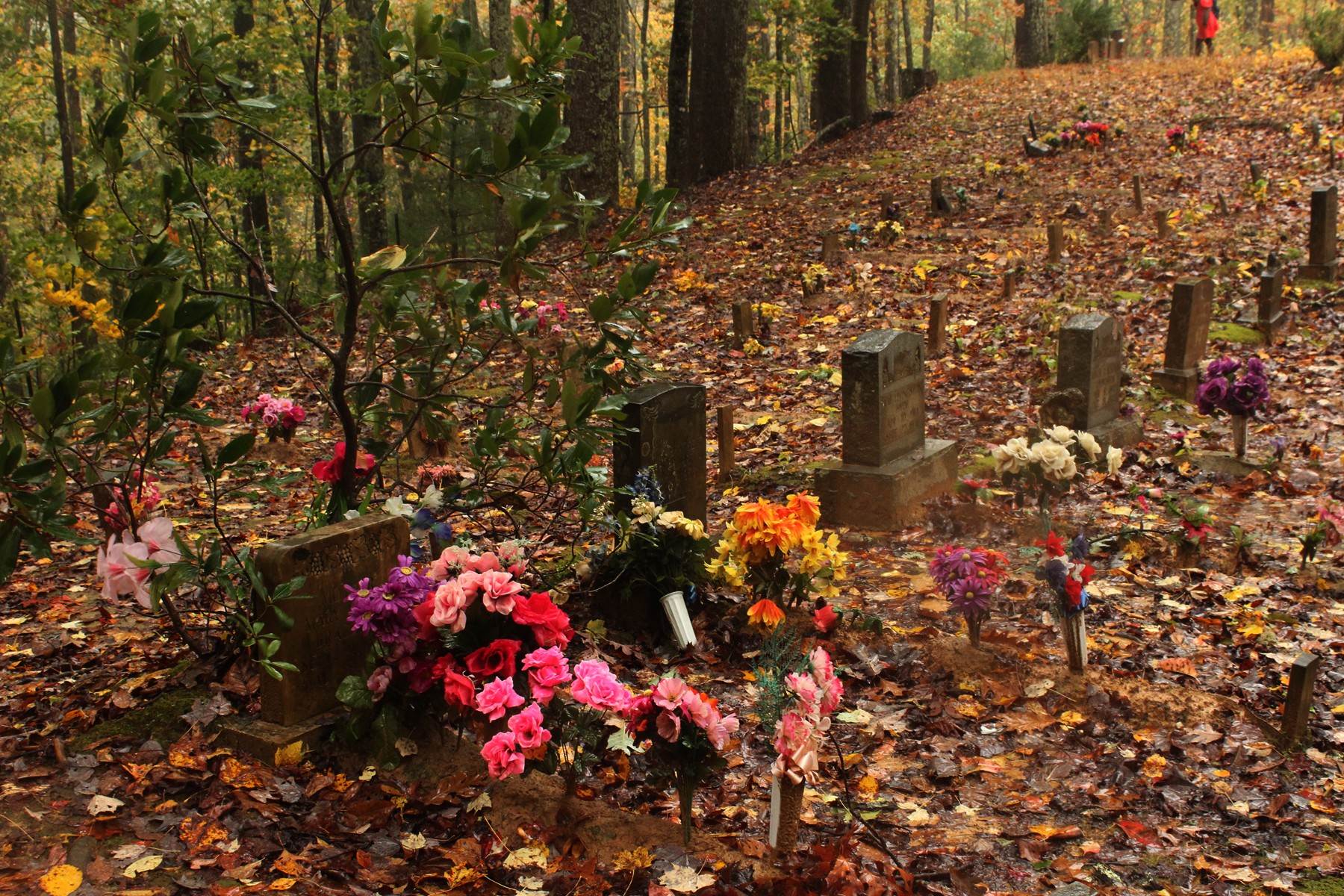
Along the Lakeshore Trail, there are many cemeteries just a few feet off the path. Have you ever wondered why they’re there?
What Lies Beneath the Lake
In 1910, the W.M. Ritter Lumber Company began logging the massive trees in the Hazel Creek basin area and built the mill town of Proctor. When the company left in 1928, the land eventually became part of the Great Smoky Mountains National Park in 1934.
A decade later, in 1944, nearly 600 families were forced to leave the area when the Tennessee Valley Authority (TVA) built the Fontana Dam. The dam was constructed to generate electricity for the Alcoa plant near Knoxville, helping supply the nation’s wartime demand for aluminum used in aircraft production.
The creation of Fontana Lake flooded many valley towns and communities. More than half of the displaced families came from between Hazel Creek and Bryson City – meaning they not only left their homes but also the graves of loved ones behind.
In earlier times, when organized cemeteries were rare, families buried their dead near their homes. Simple markers of stone, rock, or wood identified these resting places. Some graves were relocated before the flooding, but most remained. Some lie silent beneath the water and others on the higher slopes are still visited by descendants today.
Many of the gravestones in these Lakeshore Trail cemeteries mark the lives of children—tiny markers for lives cut short. Before the advent of modern medicine and vaccines, disease claimed many infants and young ones. Some stones bear no names at all, simply the word “Infant.”
A Brief History of Gravestones
In early America, gravestones were simple—usually marked with the deceased’s name, age, and year of death. Gradually, churchyard burials evolved. From 1650 to 1900, both slate and sandstone were popular; the inscriptions were shallow yet readable.
By the 19th century, public cemeteries began to develop, and gravestones became more ornate. Headstones sometimes bore epitaphs and included full birth and death dates.
During the Victorian era (1837–1901), Queen Victoria’s mourning for her husband, Prince Albert, changed death customs and practices even here in America. In both England and North America, cemeteries transformed into park-like spaces with lavish and decorated gravestones.
Preserving the Past: The North Shore Cemetery Association
The North Shore Cemetery Association, formed in 1977, is a non-profit organization dedicated to preserving the cemeteries and history of the Fontana Basin.
“Organized in 1977, with an immediate aim to gain general access to the cemeteries of the North Shore in conformity of the contractual agreements that formulated in 1943 between Federal, State and County Agencies. Another aim of the Association was the planning of decorations for the cemeteries along the North Shore of Fontana Lake as were held in the area before 1943 and the removal of families. It was and is made up of former residents and their descendants who lived in this area and whose land was taken for the building of the Fontana Dam and Basin area.”
Visi the Fontana Marina in Graham County for schedules of pontoon trips to the cemeteries. If you attend a Decoration Day, you might even hear old family stories from the descendants who were forced to leave their homes.
Visiting Lakeshore Trail Cemeteries With Respect
While hiking the Lakeshore Trail or exploring elsewhere in the Great Smoky Mountains National Park, you’ll find that most cemeteries aren’t marked on maps. Generally, if you see a trail going off to the side of the main trail with a “No Horses” sign, that trail usually leads to a cemetery.
A visit to a graveyard can teach us a great deal about how people lived. The engravings and symbols on gravestones reveal not only grief but also the history and culture of a community – what they valued and how they remembered those they lost. Wander respectfully and read the epitaphs on the stones. Each one tells a story and gives us a tiny look at what it was like to live in these mountain before the creation of Fontana Lake.
Kim Hainge, author